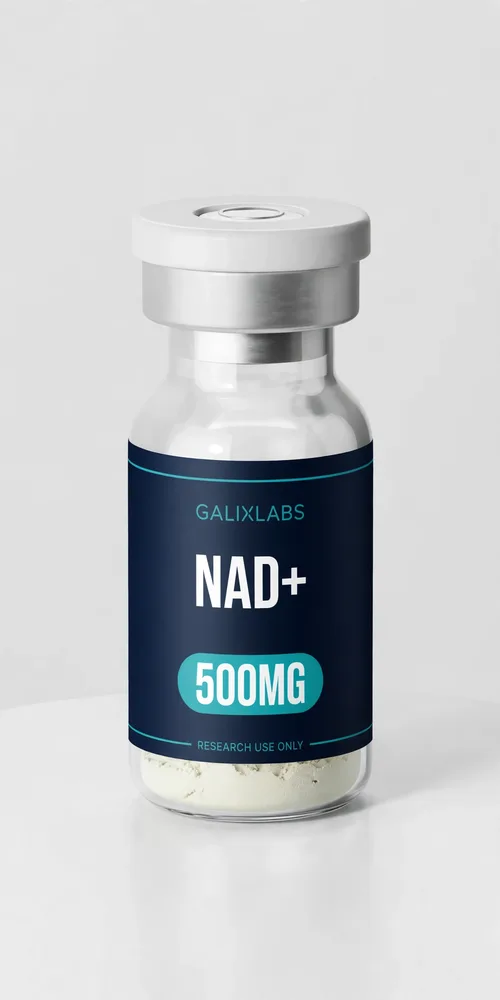
Coenzyme
NAD+ 500mg
$30
In stock
500 mg vialBatch docs pending
Coenzyme researched in cellular metabolism and redox models.
For laboratory research use only. Not for human consumption.
Order at GalixLabs
$30
In stock
Coenzyme researched in cellular metabolism and redox models.
For laboratory research use only. Not for human consumption.
Order at GalixLabsNAD+ (nicotinamide adenine dinucleotide, oxidized form; also called nadide) is a coenzyme found in every living cell. GalixLabs supplies it as a 500 mg vial for in-vitro and other non-clinical laboratory research. PubChem lists NAD+ under CAS 53-84-9 with the formula C21H27N7O14P2 and a molecular weight of 663.4 g/mol.
Structurally, NAD+ is two nucleotides joined through their phosphate groups: one carries an adenine base and the other nicotinamide. The nicotinamide ring is the reactive center. It accepts a hydride ion to form NADH, which makes the NAD+/NADH pair one of the main electron carriers in glycolysis, the tricarboxylic acid cycle, and mitochondrial oxidative phosphorylation. Researchers often use the NAD+/NADH ratio as a readout of cellular redox state.
NAD+ is also consumed as a substrate, not only cycled as a cofactor. Sirtuin deacylases, poly(ADP-ribose) polymerases (PARPs), and the NAD+ glycohydrolase CD38 all cleave it and release nicotinamide. This links NAD+ availability to protein acylation, DNA-damage signaling, and calcium signaling. Reviews of NAD+ metabolism describe the biosynthetic routes (de novo from tryptophan, Preiss–Handler, and salvage), how NAD+ is distributed between cellular compartments, and the methods used to measure it. These topics make up much of today's in-vitro research.
Common laboratory uses include enzymatic and dehydrogenase assays, cofactor supplementation in cell-free systems, sirtuin and PARP activity assays, and use as an analytical standard for LC-MS measurement of NAD metabolites.
Batch documentation. A certificate of analysis has not been posted for the current lot. When third-party testing is complete, it will be linked here and on the COA hub. Until then, we make no purity claim.
Handling. NAD+ absorbs moisture. Store the sealed vial frozen (−20 °C), dry and protected from light, and let it reach room temperature before opening. Solutions are least stable at alkaline pH and higher temperatures.
NAD+ is sold strictly as a research chemical. It is not a drug, food, dietary supplement, or cosmetic and is not intended to diagnose, treat, cure, or prevent any condition.
| Format | 500 mg vial |
|---|---|
| CAS number | 53-84-9 |
| Molecular formula | C21H27N7O14P2 |
| Molecular weight | 663.4 g/mol |
| COA | Not yet posted — batch documentation pending |
References are provided for background on published laboratory research. They are not claims about this product's use outside the laboratory.